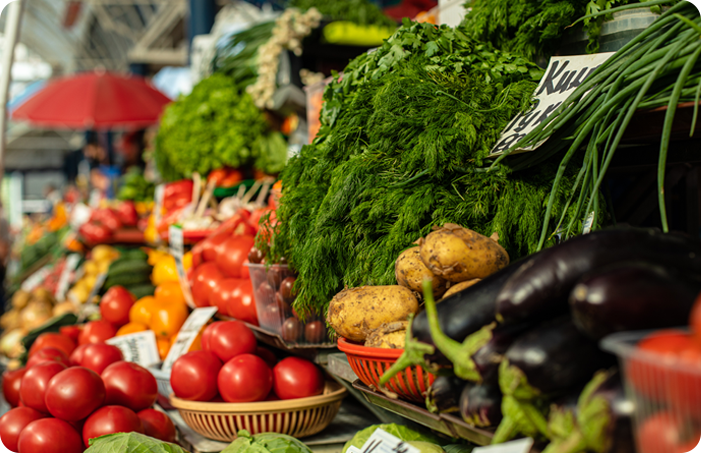

BLUMI-Med addresses the diversity of local urban and peri-urban markets in the Mediterranean and studies them as part of wider food systems.
The project looks at how these markets are connected to production, distribution, processing, marketing, and consumption, while also considering their environmental, economic, social, cultural, and governance dimensions.

BLUMI-Med will develop an Integrated Local Urban Market Sustainability Assessment (IMSA) to capture the characteristics, determinants, and sustainability of local urban markets.
The IMSA provides a conceptual and methodological framework for studying different types of markets and identifying context-sensitive pathways to improve their sustainability and upscaling.
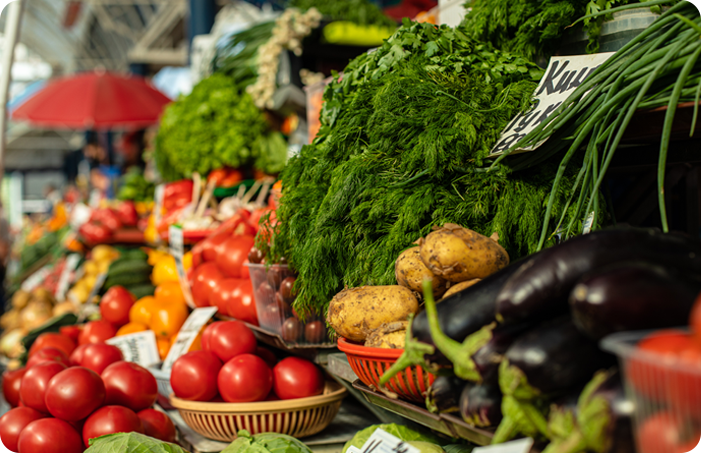
BLUMI-Med relies on a Multi-Actor Approach (MAA) that brings together researchers and relevant stakeholders, including farmers, consumers, vendors, municipalities, policymakers, technology providers, civil society organizations, and other market actors.
Stakeholders are involved in co-designing the research, evaluating results, and developing practical recommendations and solutions that respond to each market's specific context.

The project combines qualitative and quantitative methods to study local urban markets and their food systems. These include:
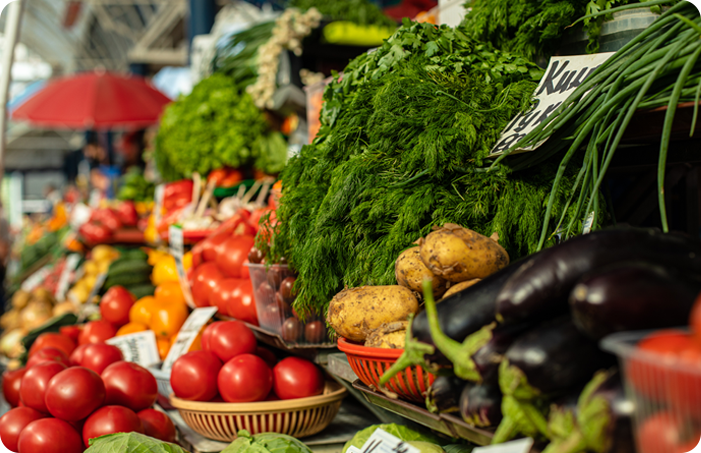
BLUMI-Med studies local urban markets from a food system perspective. This means looking not only at the market itself, but also at the wider relationships between producers, traders, consumers, institutions, policies, infrastructure, and the natural resource base.
The framework also considers the Water-Energy-Food nexus, ecosystem services, circular economy potential, gender dimensions, food security, consumer health, and the social and cultural value of markets.

BLUMI-Med explores innovative ICT-based solutions, governance approaches, and business models that can support local urban markets.
These may include tools for farm-to-consumer connections, food supply tracing, virtual produce trading, processed food e-platforms, production intelligence, farm management services, and financial technology for small farmers.
The project will assess these solutions in relation to local needs, data availability, consumer behaviour, market conditions, and sustainability potential.

Findings from the case studies will support the development of practical tools, market typologies, policy recommendations, communication activities, and ICT-related business models.
The aim is to make results useful for policymakers, municipalities, market administrators, producers, entrepreneurs, researchers, and local communities working to improve the sustainability of local urban markets.